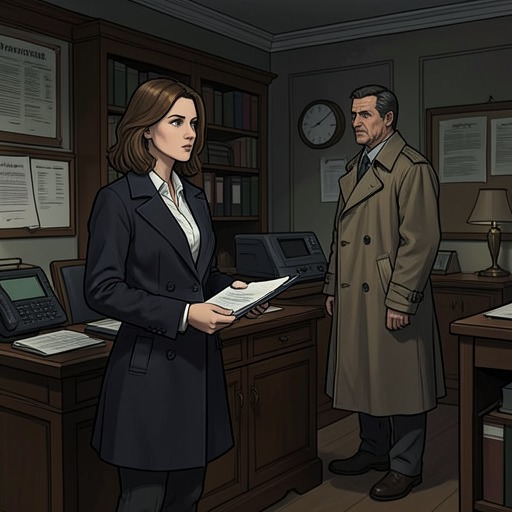
Things aren’t always how they appear
The Son“Things aren’t always how they appear” is a principle of interpretation that Simon puts into practice: a scene’s familiar explanation may be a misleading surface, and its overlooked details can expose the work of concealment. At Agnete Iversen’s house, he treats the crooked picture, chipped nail polish, missing blood traces, and a stain in the bedroom carpet as parts of a single argument against the apparent burglary.
The Phrase as a Method
Simon states the phrase while examining a case in which earlier police investigations had pointed in entirely different directions. The words do not themselves solve the case; they announce a willingness to reconsider what the available evidence seems to mean. His pause before explaining further—closing his eyes and taking a deep breath—marks the effort involved in returning to an unresolved investigation.
Reading the Scene
At the house, Simon observes that the picture is the only thing hanging crooked in a house otherwise kept carefully, as he understands it, by Mrs Iversen. Nail polish on the frame near the door matches the chipped polish on Agnete’s left middle finger. Simon reads this as evidence that she struck the frame while staggering back inside, rather than being shot in the doorway and simply moving backward. The small domestic irregularity becomes a clue to the sequence of events.
Simon then accounts for the absence of fingerprints on the door handle, including the family’s: he argues that the killer wiped it, rather than Agnete having cleaned it immediately after her husband and son touched it. He also proposes that the killer mopped blood from the floor after stepping in it, in order to avoid leaving shoeprints, and wiped the soles of his shoes. But drying the soles would not remove blood lodged in their tread. Simon predicts that fibers from a thick bedroom rug would draw out that blood and leave a rectangular stain in the carpet, a claim that could be checked by the blood technician.
Challenging the Burglary Explanation
Simon’s reasoning also tests the proposed motive. He argues that a burglar seeking valuables would have taken Agnete inside and forced her to reveal the combination to the safe expected in a house like hers. Instead, she was shot where neighbors could hear. In Simon’s interpretation, the killer’s careful removal of evidence indicates calculation rather than panic, while the limited theft was designed to make the death look like a burglary gone wrong.
The apparent burglary therefore functions, in Simon’s account, as a cover story for an investigation. A hurried or inexperienced investigator might accept the missing jewelry as sufficient explanation and fail to search for the real motive. The phrase captures this double structure: evidence can be visible yet misread when a convenient surface account is allowed to stand in for scrutiny.
Investigative and Narrative Significance
The expression connects Simon’s general warning to a concrete chain of inferences. The picture frame and chipped polish suggest movement; the cleaned handle and floor suggest deliberate evidence removal; the carpet stain offers a testable trace; and the mismatch between the killing and ordinary theft challenges the case’s initial classification. His interpretation is not presented merely as intuition: he specifies what the blood technician should find and why.
The exchange also makes the phrase a challenge to professional complacency. Simon’s colleague Åsmund Bjørnstad dismisses the reconstruction and insists that the case remains a burglary, but Simon’s details leave him less confident. The principle is thus both a rule for reading clues and a warning against premature certainty: appearances become dangerous when investigators stop asking what produced them.